

Overview
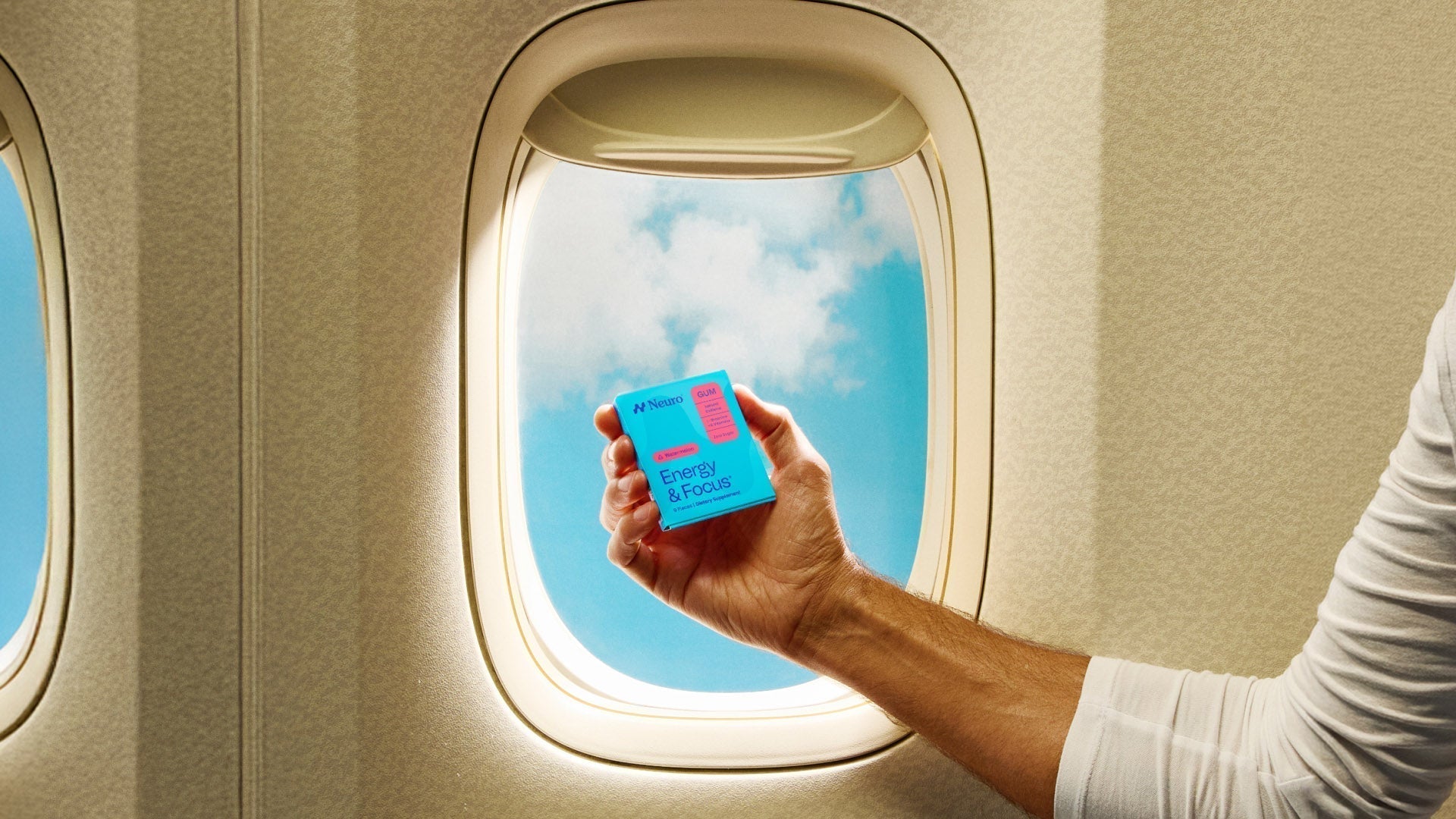
This is a practical guide to managing jet lag through smarter caffeine use. In this guide, you'll find what caffeine does to a sleep-disrupted circadian clock, why eastbound travel hits harder than westbound, and why airport coffee is a less effective strategy than it might seem. It outlines the science on dose and timing, clarifies why the L-theanine pairing matters, and lays out a practical caffeine playbook for the most common flight scenarios.
Intro
Nobody searches 'what is jet lag' while they’re on the plane. They search it at 2pm local time, the third day in, when the brain fog still hasn't lifted and they've already had four coffees. Circadian biology is well documented— you can find the science anywhere. What it won’t prepare you for is landing at the terminal at 6 a.m. with a client meeting at 9.
That's the gap this piece of writing fills. It doesn't attempt to explain what jet lag is. Instead, it focuses on the practical side: what caffeine actually does to a sleep-disrupted body clock, why dose and timing matter more than most travellers realize, and why the format you choose for that caffeine is a more significant question than it might seem.
The Traveler's Real Enemy Isn't the Flight. It's What Comes After.
The flight gets the blame because it's the uncomfortable part. But jet lag symptoms - disorientation, mood instability, slower reaction time, difficulty concentrating - don't peak on the plane. They peak after you land, when the adrenaline of travel wears off and your internal clock realizes it's been relocated without consent.
According to the Cleveland Clinic, symptoms can persist for several days depending on how many time zones you've crossed.* For a consultant with back-to-back meetings starting the morning after an overnight, that timeline is a problem.
Jet lag is a circadian disruption, not just tiredness. Your body regulates sleep, alertness, digestion, and hormone cycles on a roughly 24-hour internal clock. Cross enough time zones fast enough and that clock is still running on origin time while your calendar is asking you to perform on destination time. The gap between those two things is what jet lag actually is.
Eastbound vs Westbound: Why Direction Matters
Eastbound travel is harder. Your internal clock adjusts more readily to a longer day - which is what westbound travel gives you, effectively - than to the shorter one that eastbound requires. Beaumont et al. (PubMed 12959951) measured this directly: eastbound travelers showed significantly greater performance decrements after rapid transmeridian travel than their westbound counterparts.*
NYC to London, Chicago to Berlin, LA to Tokyo - those routes carry a steeper jet lag penalty. If you're the consultant flying Sunday night for Monday morning, you're working against the harder case. Worth building your caffeine strategy around that fact rather than around the assumption that a strong coffee on arrival will sort it out.
Why Airport Coffee Isn't the Answer
Terminal coffee has a branding problem: it looks like a solution because it's familiar and because airports have made it impossible to avoid. But an 8oz drip coffee can carry anywhere from 80mg to 150mg of caffeine depending on roast, brew method, and the specific terminal cafe's equipment on that particular morning. Order two, which most exhausted travelers do, and you might be at 300mg before you've cleared customs - without knowing it. That's not a caffeine strategy. That's guessing.
The timing problem is where it gets more consequential. Caffeine's half-life runs roughly three to five hours, which means a 10 am coffee still has meaningful concentration in your system by mid-afternoon. If your destination's local bedtime is 10 pm and you're trying to resync your clock, caffeine at 3 pm is working against that process.
There are also the purely logistical annoyances that add up on a travel day: the queue that eats into your boarding buffer, the hot cup you're managing through security while also handling a carry-on, the sugar-heavy airport cafe drink that front-loads energy for a crash an hour into the flight. None of that is helping. It's just familiar.
The Science of Caffeine and Jet Lag
Caffeine doesn't fix jet lag. Your circadian clock resynchronizes at roughly one time zone per day going eastbound, a little faster westbound, and no amount of caffeine changes that rate. What the research actually shows is something more specific and more useful: caffeine can meaningfully buffer the alertness deficit while your clock catches up.
The Beaumont et al. study (PubMed 12959951) found that caffeine helped manage daytime sleepiness caused by jet lag, with the effect most pronounced on eastbound travel where the performance hit is sharpest.* That's a practical finding for arrival-day performance, even if it doesn't touch the underlying clock problem.
A study in Science Translational Medicine (Burke et al., PMC4657156) added something that most travelers haven't heard: caffeine doesn't just mask fatigue - it has measurable effects on the human circadian clock itself, both in vivo and in vitro.* Timed well, it may actually assist the resynchronization process. Timed poorly - say, caffeine taken late evening at your destination - it can actively delay it. This is not a small distinction. The same dose of caffeine that helps you perform on arrival morning can make day-two adjustment harder if it disrupts your first night of local-time sleep.
Caffeine's Half-Life and Why It Matters for Sleep
The math is worth doing once so you don't have to think about it again. With a five-hour half-life, 100mg taken at noon is down to roughly 12.5mg by midnight. With a three-hour half-life - faster metabolizers, no genetic variants slowing clearance - that same dose is negligible by 9 pm. Most people are somewhere in between, which means a good rule of thumb is cutting off caffeine at least six to eight hours before your destination's bedtime. On arrival day in London after an overnight from New York, that's early afternoon at the latest. Earlier is better.
For a detailed look at caffeine's effect on cognitive performance specifically, Neuro's pilot study on focus with BrainCo Inc. covers the measurement side of this in depth.*

A Frequent Flyer's Discreet Energy Toolkit
The jet lag conversation at the medical-authority level - Cleveland Clinic, Mayo, the PubMed literature - focuses on what caffeine does biologically. It doesn't usually address the practical question of format: how you're actually supposed to carry, dose, and time caffeine in an environment where you're moving through security, boarding a flight, and presenting slides within a twelve-hour window.
Format is where Neuro Energy & Focus Gum solves a problem that brewed caffeine doesn't. Each piece contains 40mg of natural caffeine plus 60mg of L-theanine, B6, and B12.* The 40mg increment matters for dosing: you know exactly what you're taking, you can add a second piece an hour later if needed, and you're not committed to a full cup's worth at once. The Extra Strength version is 100mg per piece - roughly a standard drip coffee - for situations where you need that level and want the precision.
The L-theanine pairing is worth understanding specifically. Owen et al. (PubMed 18681988) found that the combination of L-theanine and caffeine improved speed and accuracy on attention-switching tasks compared to caffeine alone.* A follow-up by Giesbrecht et al. (PubMed 21040626) replicated this and specifically noted reduced susceptibility to distraction.* If you're running on fragmented sleep and trying to hold a coherent thought in a client meeting, that specific effect - calmer, less scattered alertness - is more useful than the raw stimulation you'd get from caffeine alone.
Neuro in a TSA-Safe Travel Kit
Solid, fits in your pocket, no liquid rule, no spill risk. You don't need a free hand or a flat surface to use it. These are minor conveniences individually and they add up when you're navigating a connection with a carry-on in one hand and a boarding pass on your phone. The Energy & Focus Mints carry the same 40mg formula in mint format - same ingredient stack, different form factor for anyone who prefers it.
Quick Reference: Caffeine Per Source
|
Source |
Approx. Caffeine |
|
Airport latte (12 oz) |
150-200mg (highly variable) |
|
Energy drink (standard can) |
80-300mg (varies widely) |
|
Caffeine pill (standard) |
100-200mg, no L-theanine |
|
Neuro Energy & Focus Gum |
40mg per piece + 60mg L-theanine* |
|
Neuro Extra Strength Gum |
100mg per piece + 60mg L-theanine* |
*Based on verified Amazon product listings and neurogum.com product pages.
Caffeine Timing Playbook for Common Flight Scenarios
Direction, departure time, and how many hours until your destination's midnight determine the caffeine strategy more than anything else. These aren't rules - they're starting points.
Eastbound overnight (e.g., NYC to London):
The goal in-flight is sleep, not alertness. Caffeine taken before boarding will still be active when you should be trying to rest. Skip it, or keep it very light before departure. On arrival - morning local time, probably after five or six hours of broken sleep in a window seat - one piece of Neuro Energy & Focus Gum gives you a controlled 40mg lift as you clear customs and find your hotel.
Cut off entirely by early afternoon local time. Pushing through with more caffeine at 4 pm London time means you'll be wired when 10 pm arrives, and a bad first night makes day two harder.
Westbound day flight (e.g., NYC to LAX):
Westbound is the more forgiving direction. Your clock is being asked to extend the day, which it does more readily than compressing it. Small caffeine doses spaced through the afternoon - on arrival, not on the flight - help you stay on destination time without banking a large hit that lingers into the evening. LA bedtime is three hours later than New York, so you have more runway, but don't mistake that for permission to caffeinate through dinner.
Domestic red-eye (e.g., SEA to JFK):
Sleep on the flight if you can. That's the whole strategy for the first several hours. The caffeine question is really about the last hour before landing: one piece of gum gives you the alertness ramp for morning meetings without having pushed stimulants through your system all night. Arrive dehydrated, as most red-eye passengers do, and the fatigue reads worse than it actually is - hydration does more work per hour on arrival morning than a second piece of gum.
Business traveler's morning meeting on arrival day:
One piece of Extra Strength is 100mg - the equivalent of a standard drip coffee - but the dose is exact every time. The hotel lobby coffee might be 80mg or 140mg depending on who made it. Pair with a full glass of water, not more coffee. If you've already had two cups at the airport, track the total: 100mg on top of 200mg puts you at 300mg, which is still inside the FDA's 400mg daily guideline for healthy adults, but you're approaching it. Travel days are when the count gets away from people.*
|
Flight Scenario |
Caffeine Approach |
Key Constraint |
|
Eastbound overnight |
Minimal in-flight; 1 piece on arrival morning |
Cut off 6-8 hrs before destination bedtime |
|
Westbound day flight |
Small spaced doses on arrival afternoon |
Later bedtime - don't push into evening |
|
Domestic red-eye |
Sleep in-flight; 1 piece near landing |
Hydrate before caffeinating on arrival |
|
Morning meeting, arrival day |
1x Extra Strength (100mg); track daily total |
Know your running total across all sources |
What to Pack for Discreet Focus
Caffeine is one input. Jet lag is a circadian disruption problem, which means it responds to multiple signals - light, food timing, activity, and yes, caffeine - but it's not solved by any one of them alone.
For the caffeinated phase of the day, Neuro Energy & Focus Gum at 40mg increments gives you the flexibility to dose up or down based on how you're actually responding.
On arrival mornings, whether you’re feeling functional or not, Neuro Energy & Focus Gum, with 40mg of caffeine, lets you adjust without committing to a full coffee's worth.*
For evening arrivals or the wind-down portion of the day, the caffeine-free Memory & Focus Gum contains Cereboost Ginseng and L-theanine for cognitive support without sleep interference.
When you still have a few hours of emails before bed but can't afford to push your sleep later, Memory & Focus Gum is useful for a late-arriving flight.*
A refillable water bottle is probably the most underrated item on this list. Cabin air at altitude is extremely dry, and most long-haul passengers arrive dehydrated even if they didn't have a single drink—often without recognizing it.
Dehydration amplifies fatigue, headache, and cognitive fog in ways that look like jet lag but respond to water, not caffeine. Drink before you reach for the gum.
Blue-light blocking glasses are optional, but the mechanism is real: blue light suppresses melatonin production and signals "daytime" to your circadian clock. Wearing them before destination bedtime—on the plane, in the lounge, or on the way from the airport—reinforces the sleep signal.
If your doctor has recommended melatonin for jet lag, it's serving a different function than caffeine. Beaumont et al. (PubMed 12959951) specifically examined both compounds in the transmeridian travel context - they're complementary tools, not alternatives.
What doesn't belong in the travel kit is the expectation that caffeine substitutes for sleep. It doesn't, and leaning on it too hard on day one makes the resync harder on days two and three.
When to Skip the Caffeine Altogether
Not every landing warrants a caffeine strategy. There are a few specific cases where leaving the gum in your bag is the smarter call.
Short trips - 24 to 48 hours, back to the same time zone by Thursday - often don't warrant resynchronization at all. If your body holds home time, there's less to undo when you land back. Pushing to adjust for two days and then reversing it is sometimes more disruptive than just tolerating the slight offset.
If you've already hit or approached 400mg from other sources across the day - which is easy to do on a travel day with hotel breakfast coffee, airport coffee, and a soda at lunch - adding more isn't the move. Track the total. It's the aggregate that matters, not any single source.
And some of what passes for jet lag on day two is just sleep debt from a short or uncomfortable night. Caffeine can support performance through it, but the underlying deficit resolves with sleep, not stimulants. Sometimes the most effective jet lag strategy is getting to bed at local time on arrival night and accepting a slow morning.
Frequently Asked Questions
Can I bring Neuro Gum and Mints through airport security?
Yes. Gum is a solid and is not restricted by TSA's 3.4-oz liquid rule. Always check your destination country's customs rules for any supplements.
Will caffeine gum actually help my jet lag?
Research suggests caffeine can help manage daytime sleepiness associated with jet lag, particularly for eastbound travel.* It doesn't cure jet lag, but it can support alertness at strategic moments - like an important meeting right after landing.
How is Neuro different from caffeine pills?
Neuro Energy & Focus provides 40mg of caffeine per piece, while Neuro Extra Strength Energy & Focus steps that up to 100mg, both paired with 60mg L-theanine, B6, and B12 - a multi-ingredient formula that caffeine-only pills don't offer (verified Amazon product listings).* The L-theanine pairing has published research support for improving focused, calmer alertness compared to caffeine alone.
Is there a version I can take on evening flights without wrecking my sleep?
Yes. Neuro Memory & Focus Gum is caffeine-free and contains Cereboost Ginseng, L-theanine, B6, and B12 - suitable for when you want cognitive support without caffeine's sleep interference.*
Can I use Neuro as my only jet lag strategy?
No single product fixes jet lag. Caffeine is one tool - hydration, light exposure, meal timing, and strategic sleep all matter. For severe or recurring jet lag, consult your healthcare provider.
Ready to Travel Smarter?
The medical sites will tell you what jet lag is. This is what to actually put in your bag. The Neuro Bundle covers the full arc: caffeinated focus for arrival day, the standard 40mg daily dose, and the caffeine-free wind-down for when you're trying to push your sleep toward local time without losing all cognitive function in the process.
*These statements have not been evaluated by the Food and Drug Administration. This product is not intended to diagnose, treat, cure, or prevent any disease.


