

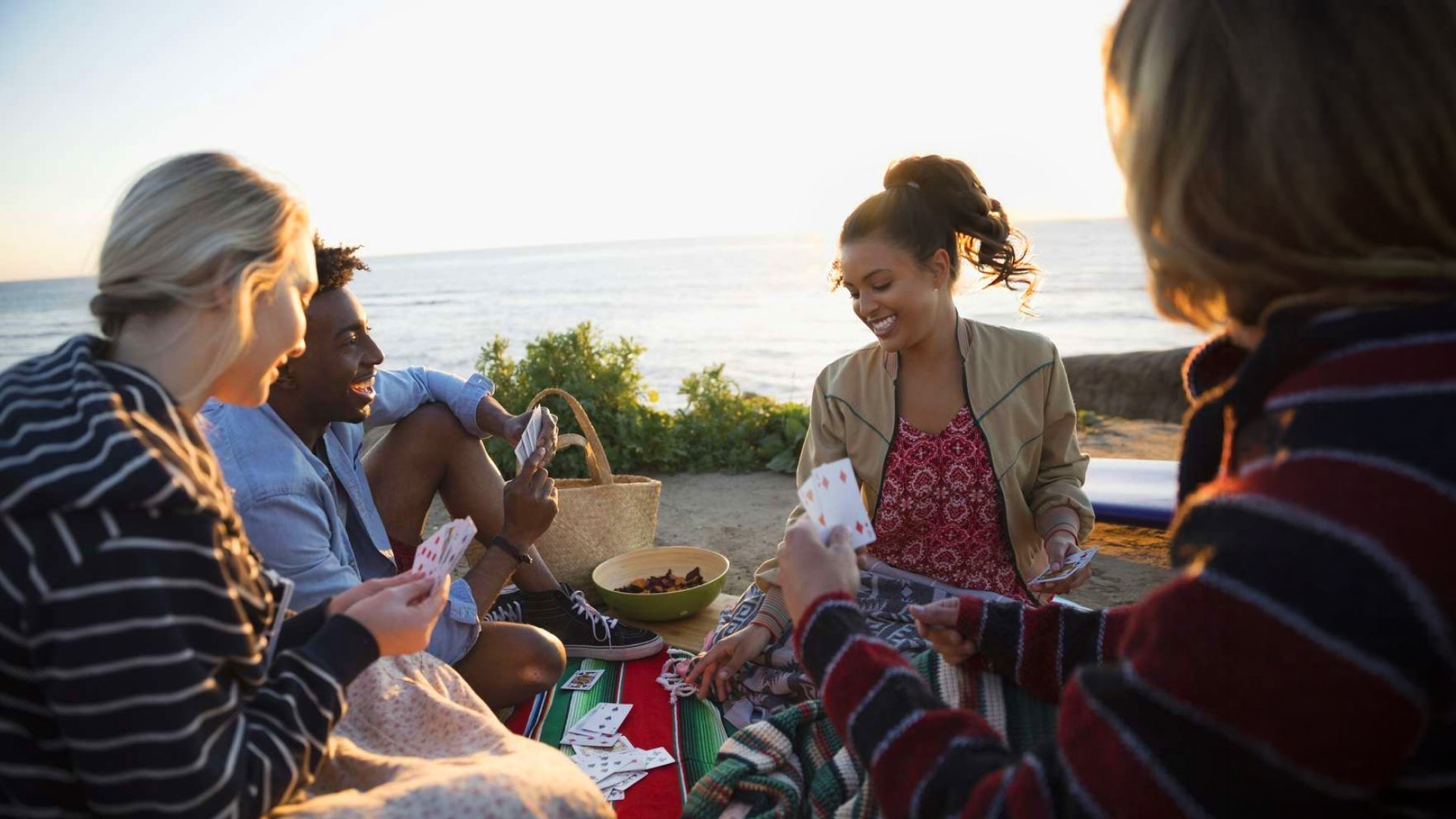
A deck of cards is the most underrated thing you can pack for a beach day. No batteries, no charger, doesn't care about sand, fits in the side pocket of literally any bag, and while you're squinting at your hand trying to remember what's already been played, it's quietly giving your brain a real workout.
Let’s chat about the best beach card games and the actual science on why they're good for your memory.
Overview
- Card games are linked to sharper cognition. They're an enjoyable, low-cost way to exercise memory, attention, and planning — though they're a healthy habit, not a magic bullet or a cure.
- The research is promising. A 2021 controlled trial found game-based training produced lasting gains in verbal fluency, and a decade-long study of nearly 12,000 older adults linked regular card play with lower dementia risk (an association, not proof).
- Different games train different skills. Concentration builds pure memory; rummy, bridge, and trick-taking games work strategy and working memory; cribbage sharpens mental math; solitaire is a strong solo option.
- How you play matters. Play regularly rather than in bursts, keep raising the difficulty, mix up your games, and play with others when you can.
- Pair it with the basics. Card games work best alongside good sleep, exercise, a solid diet, and staying socially connected.

- 3 months — how long verbal fluency gains held after game-based training in a 2021 controlled trial
- 11,821 adults — tracked for a decade in a study linking daily card play with lower dementia risk
- 1 deck — all the equipment required. No app, no subscription, no charger.
Best Card Games for the Beach
Not every card game belongs on a beach towel. The best ones are fast to learn, fun with a group of any size, and don't fall apart the second a gust of wind gets involved. Here's the beach-day lineup:
Speed — Two players, no turns, pure reflexes and pattern-spotting. Loud, fast, and a genuinely good workout for quick visual recall — you're scanning both piles at once.
Egyptian Ratscrew (Slap) — Chaotic in the best way. Everyone's watching for doubles and sandwiches and slapping the pile — reaction time and pattern memory, dressed up as a party game.
Rummy — Travels well, plays with 2–6, and keeps everyone quietly tracking what's been picked up and discarded. Easy to pause mid-hand for a swim break, easy to pick back up.
Go Fish — The whole family's game. Simple rules, but don't underestimate it — remembering who asked for what a few turns back is a real memory drill for kids and adults alike.
Spoons (or Pig, with no spoons handy) — Group energy, fast rounds, everyone watching everyone else's face for tells. Great for a bigger crew spread out on a few towels.
Bring a deck with a snap-shut case (keeps the sand out), and play on a towel or cooler lid rather than loose sand — cards stay put and the wind stays out of it.
Can Card Games Really Improve Memory?
Good news first: the research is more encouraging than you'd expect. The honest version comes with limits, so let's walk through both.
A 2021 double-blind randomized controlled trial in the International Journal of Geriatric Psychiatry trained healthy older adults on modern board and card games and compared them to a paper-and-pencil training group. Both groups improved on verbal fluency — but only the game-playing group still had that gain three months later. That's the kind of staying power you actually want from a brain-training habit.
Zoom out and the pattern holds. A 2022 cohort study in Frontiers in Aging Neuroscience followed 11,821 adults 65+ for roughly ten years. The people who played cards or mahjong almost daily had a significantly lower risk of developing dementia than those who rarely played. It's an association, not a cause-and-effect proof, but tracking that many people for that long carries real weight.
The leading theory: cognitive reserve. A mentally active brain builds a buffer that helps it stay resilient. Every hand of cards — tracking what's played, weighing your options, planning ahead — is a rep for working memory, attention, and executive function, all at once.
And the honest caveat, straight from consumer-health reviews like GoodRx's roundup: the benefit is real, but modest. Card games work best next to the fundamentals — sleep, movement, food, people. Think of them as one piece of a bigger picture, not the whole picture.
Beyond the Beach Bag: Card Games by What They Train
Once the beach towel's packed up, the game doesn't have to stop. Here's the fuller lineup, sorted by what each one is actually training.
Best for pure memory
Concentration (aka Memory, aka Pairs)
Cards face-down, flip two at a time, hunt for matches. The most direct workout there is for visual-spatial memory. Your only job is remembering where things sit. Easy to learn, genuinely hard to master.
Solitaire
The reliable solo option. Sequencing, sustained attention, and quietly keeping track of what's in play and what's still coming.
Best for strategy and working memory
Rummy and Gin Rummy
Build your sets and runs while clocking what everyone else is picking up and discarding. Constant tracking, constant working-memory rep.
Bridge
Often called the heavyweight of card games — memory, logic, and partnership strategy all at once. A game you can grow into for years.
Trick-taking games (Spades, Hearts, Euchre)
Remember what's hit the table, deduce what's left in everyone's hand, decide accordingly. Good, fast decision-making practice.
Cribbage
A tidy little engine for mental math: fifteens, pairs, runs, pegging your score as you go. Centuries old, but has stood the test of time.
Best for a fresh challenge
Modern strategy and deck-building card games
The kind used in the actual 2021 research. It involves new rules and new mechanics, since a brain on autopilot isn't training anything.

How to Actually Train Your Brain With a Deck of Cards
A few simple principles will help you turn casual play into a genuine mental habit.
-
Keep raising the difficulty. Once a game feels automatic, it's stopped training anything. Add a harder variant, a tougher opponent, or a new game.
-
Play often, not in marathons. A few short rounds a week beats one long session a month — that's what the research actually tracked.
-
Bring people in. Social play stacks conversation and read-your-opponent thinking on top of the game itself. Two workouts for the price of one.
-
Mix your games. Rotate a pure-memory game, a strategy game, and a math-driven one so you're not just training the same muscle on repeat.
-
Pair it with the basics. Sleep, movement, healthy food. Game night is the complement, not the substitute!
Who Benefits Most?
The short answer: almost everyone.
Most of the strongest research is in older adults, so this is an especially good habit to build as the years add up. But there's no minimum age for "keep your brain busy." A lunch-break round of solitaire, a Friday bridge night, a family game after dinner — it all counts. Starting earlier just means more years of the habit compounding.

Give Your Focus a Little Backup
A good hand of cards already has your brain tracking, planning, and remembering, but a little boost of focus helps you find your flow state.
Neuro Memory & Focus™ Gum is caffeine-free and built for exactly this kind of moment. Every piece packs:
- Cereboost® American Ginseng: a patented extract studied for supporting mental clarity
- L-theanine: for calm, alert attention (no jitters riding along)
- Vitamins B6 & B12: the everyday workhorses behind normal energy and brain function
No caffeine, no crash, no wrong moment to reach for it. Vegan, gluten-free, zero sugar. Up to four pieces a day.
Pack a deck. Pick a game. Keep the difficulty creeping up once it starts feeling easy.
Get a free deck of cards and a beach towel with select purchases this month, because you're going to need one.
Frequently Asked Questions
What are good card games to bring to the beach?
Look for games that are fast to learn, fun with any group size, and don't rely on cards staying perfectly still — Speed, Egyptian Ratscrew, Rummy, Go Fish, and Spoons all travel well. A deck with a snap-shut case and a towel or cooler lid to play on keeps sand and wind out of it.
Are there specific card games designed for mental exercise?
Yes. Memory games like Concentration train recall directly, while strategy games like bridge, rummy, and cribbage work on working memory, planning, and mental math. Modern deck-building games are built to be cognitively demanding on purpose; one such set was actually used in published research.
What are the best card games to improve brain skills?
Concentration for pure memory. Bridge, rummy, and trick-taking games (spades, hearts) for working memory and strategy. Cribbage for mental math. Solitaire for solo focus and sequencing.
How often should I play to see a benefit?
Research associates frequent, regular play with better cognitive outcomes. Short sessions several times a week tend to be more effective than occasional long ones, and increasing the challenge over time helps keep the benefit going.
Do card games prevent dementia?
Not provably. Large studies link frequent card play with lower dementia risk, but that's an association, not proof of prevention. It’s best to treat card games as one healthy habit among several: sleep, exercise, and staying socially connected.
*This statement has not been evaluated by the Food and Drug Administration. This product is not intended to diagnose, treat, cure, or prevent any disease.


