

Learning multiple languages requires attention, strong memory, and language retrieval. This guide highlights the cognitive challenges of becoming a polyglot, effective study strategies, and the role of targeted cognitive support in language acquisition, addressing these:
- Polyglots demand more cognitive engagement in attention and task switching.
- For multilinguals, active language use and cross-linguistic switching matter more than working memory.
- Multilingual learners are likely to experience cross-linguistic interference.
- Vocabulary recall may be compromised by insufficient repetition, stress, and fatigue.
- The most effective learning methods include spaced repetition, active recall, interleaving, speaking and writing, dual coding, and adequate sleep.
- Cereboost® can support memory and attention, regardless of its untested effects on language learning.
- L-theanine can promote calmness and focused attention, mitigating speaking nerves.
- Cereboost® American Ginseng Extract and L-theanine can reinforce proven study methods rather than replace them.
- Caffeine-free supplements can suit late-night language practices, yet ginseng-medication interactions and relevant precautions should be considered.
While speaking your second language, if you suddenly forget what to say, this situation may be related to memory overload. In such cases, mental fogginess may be experienced during long study sessions, and progress in vocabulary acquisition may also stall. At this point, polyglots and serious language learners begin to wonder about working memory.
Working memory is the mental workspace that holds new vocabulary, grammar patterns, and conversational flow when you are actively using them. This is also where Cereboost® and L-theanine can play a supportive role. This guide aims to clarify how the bilingual brain works and why vocabulary recall can become challenging.
The Bilingual Brain Is Already Working Hard
Every time a bilingual or multilingual person speaks, their brain is doing more than retrieving words. Both language systems stay active at once, which means the brain constantly has to select the right language and suppress the other. Shook and Marian describe this as a kind of built-in mental workout: executive function, attention, and task switching all get exercised more heavily in bilingual brains than in monolingual ones.
Why Bilinguals Have a Working Memory Advantage
The idea of a bilingual working-memory advantage is quite popular and supported by some interesting findings. Nonetheless, some particular evidence suggests it depends profoundly on how the two languages are used day to day.
Yang compared Korean monolinguals with Korean-English bilinguals. He found that simply knowing two languages didn’t guarantee a working memory advantage. He also noted what mattered more was whether someone regularly had to hold one language active while decoding the other in real conversation.
Amoruso and colleagues reported that people living in more multilingual regions were roughly half as likely to show signs of accelerated biological aging compared with those in more monolingual regions, an effect researchers link to cognitive reserve built up through lifelong language use. Briefly, learning and using another language is one of the more demanding, and rewarding, workouts you can give your brain.
Where Recall Fails, and Why
Language learners may unexpectedly experience moments when familiar words slip away. There are a few well-documented reasons behind this, and none of them indicate a personal shortcoming.
-
Limited Repetition
Memory fades on a predictable curve unless it gets reinforced at the right intervals, an effect first mapped by Hermann Ebbinghaus over a century ago. This principle remains supported by modern spaced-repetition research.
-
Passive Review Instead of Active Recall
Re-reading a vocabulary list feels productive. Nevertheless, it mostly establishes familiarity rather than retrieval strength. That sort of familiarity is sometimes called the “illusion of mastery,” because it might be perceived as knowledge until you are asked to retrieve the word unaided.
-
Poor Sleep Between Study Sessions
Memory consolidation, the process that moves new vocabulary from short-term working memory into longer-term declarative memory, occurs mostly during sleep.
-
Stress and Fatigue
Both stress and fatigue reduce how well new information gets encoded in the first place. This situation clearly explains why a rushed, intensive late-night study seldom leads to lasting retention.
According to Dunlosky and colleagues, spaced repetition combined with active recall outperforms almost every other study technique available, including rereading, highlighting, and summarizing.

Table I. Retention declines without review. Spaced repetition resets the curve before a word is forgotten.
There is also a multilingual version of this finding. Your native language, or L1, and each additional language you are building, or L2 and beyond, compete for the same retrieval resources. That moment of reaching for a word and getting nothing is sometimes called the “tip-of-the-tongue experience.”
In this case, flashcard apps such as Anki, Duolingo and Pimsleur come to the forefront, since they are rooted in spaced, active recall, and these apps can deliver better language-learning outcomes by repetitively showing the same word.
What the Research Says About Cereboost® American Ginseng and Working Memory
Cereboost® is a patented extract of American ginseng, or Panax quinquefolius, standardized for consistent ginsenoside content and developed by Givaudan. It has been studied in three published randomized, placebo-controlled trials in healthy adults, all focused on working memory rather than language learning specifically.
In the first trial, Scholey and colleagues gave 32 healthy young adults single doses of 100, 200, or 400 mg of the Cereboost® extract, and they found that working memory improved at all doses and across the one-to six-hour assessment period.
In a subsequent trial, Ossoukhova and colleagues tested a single 200 mg dose in 52 healthy adults aged 40-60. The study showed a similar improvement in a composite working memory score, peaking around 3 hours after dosing.
In a third trial, Bell and colleagues examined both a single dose and 2 weeks of daily use in 61 healthy young adults. The study reported improvements in working memory and attention, alongside early evidence pointing to the gut microbiome as one possible mechanism behind the effect.
One thing to note: While the working memory gains are well-documented, there is no published study that has tested Cereboost® specifically on language-learning tasks, vocabulary recall, or word retrieval. However, it is reasonable to assume that working-memory support leads to faster vocabulary acquisition.
L-Theanine, the Calm Focus Partner
The Alzheimer’s Drug Discovery Foundation describes L-theanine as an amino acid associated with relaxed alertness and increased alpha-wave activity, which may support focused attention. Also, Williams and colleagues reported that 200-400 mg of L-theanine per day may reduce stress and anxiety under acute stress.
Particularly for language learners, the effect of calm focus can have an obvious practical use. During speaking practice, anything that supports calm attention without sedation may be considered worthy of credit, separate from any working-memory claims.
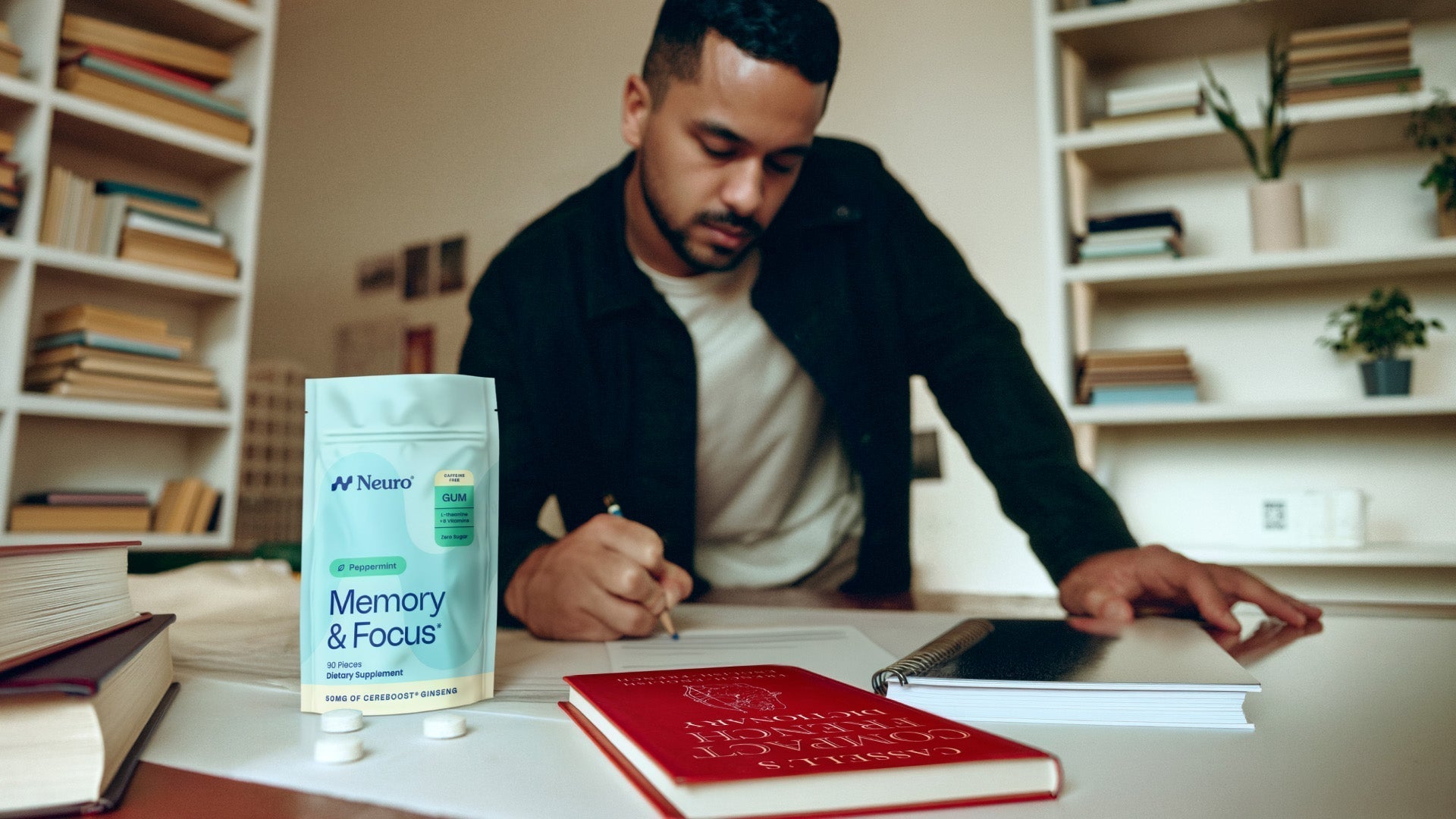
As an alternative, Neuro Memory & Focus Gum combines Cereboost® with L-theanine, vitamin B6 and B12, in a caffeine-free formula.

A Research-Backed Language Learning Routine
It’s important to note that a supplement serves only as a supportive layer within a broader language-learning program, and it can’t replace a well-planned language learning routine.
Daily Routine Template for Learners of Multiple Languages
-
Morning, high cognitive demand:
- New vocabulary through Anki or another spaced repetition app.
- Listening practices with podcasts or native-language media.
- One piece of Neuro Memory & Focus Gum (if you want cognitive support without a caffeine crash later).
-
Midday, consolidation:
- Real conversation practice through italki, Tandem, or an in-person exchange.
- Shadowing exercises, repeating audio in real time to develop pronunciation and rhythm.
-
Evening, light review, protect your sleep:
- Passive language exposure through music or subtitled TV shows.
- Avoiding heavy caffeine at least 8 hours before your bedtime because memory consolidates during sleep.
- Neuro Memory & Focus Gum again if you want support during evening study without disrupting sleep, thanks to its caffeine-free format.
-
Weekly:
- One immersion session of 2 or more hours.
- A full review of the prior week’s vocabulary.
- A day of proper rest to support memory consolidation.
- Prioritizing consistency over intensity while studying, sleeping 7-9 hours to protect what you have learned, and favoring conversation practices (3 non-negotiables based on the mentioned research above).
A Sour Option for Afternoon Focus: Neuro Energy & Focus Sour Mints
If you need something to focus during your afternoon study session and enjoy sour flavors, Neuro Energy & Focus Sour Mints may appeal to you. Available in sour apple, sour citrus, and sour berry flavors, it can satisfy unruly sour candy cravings while giving you a boost of energy and focus.
Each mint contains 40 mg of natural caffeine, 60 mg of L-theanine, Vitamin B6, and Vitamin B12, which can be helpful if you want extra support for your health. Neuro Mints are always vegan, zero sugar, and aspartame-free.
Thanks to Neuro Sour Mints, you get the sour flavor you crave and the energy you need to nail your midday conversation practice, without the dreaded sugar crash.

Beyond Supplements: What Actually Works
The following methods may be helpful if you want to learn another language:
-
Spaced repetition systems
Systems such as Anki, RemNote and SuperMemo are grounded in the forgetting-curve research of Hermann Ebbinghaus.
-
Active recalling over passive re-reading
Roediger and Karpicke showed that students who practiced recalling information through testing retained significantly more one week later than other students who only re-read the material.
-
Interleaving
Interleaving means combining various grammar points or vocabulary types in a single session, rather than focusing on only one topic. It's shown to improve long-term retention even though it may feel more challenging at first.
-
Output over input
Speaking and writing force deeper, more effortful encoding than listening or reading on their own. This is one reason why immersion becomes more effective when it includes active language production instead of exposure alone.
-
Dual coding
Pairing a word with an image, gesture, or personal association creates a second memory pathway for lexical retrieval, which is why flashcards with pictures tend to outperform text-only cards.
-
Sleeping
Both declarative memory, which involves facts and vocabulary, and procedural memory, which covers pronunciation and grammatical patterns, are consolidated during sleep.
Spaced Repetition and Supplements
Cereboost® American Ginseng and L-theanine are studied for general working memory and calm focus. Nonetheless, they haven’t been researched as specific language tools that can contribute to teaching a new language or help someone become a polyglot.
You can think of Cereboost® and L-theanine supplements as one layer of a detailed learning routine. If your language acquisition approach isn’t sufficiently aligned with your own learning style, no ingredient can compensate for that.
Safety Notes for Language Learners
-
Caffeine-free options are a popular choice for evening practice sessions, as conversation exchange sessions organized by online polyglot communities generally take place in the evening.
-
Ginseng carries potential interactions with certain medications. Therefore, you should consult your healthcare provider before combining American ginseng with medication you currently use.
-
This product is not recommended for anyone under 18 without healthcare provider guidance.
-
If you are pregnant or breastfeeding, you should seek advice from your healthcare provider before use.
FAQs
Does Neuro Memory & Focus Gum help me learn languages faster?
Supplements can’t teach you a language, since language-learning requires practice and your active involvement in the process. Nevertheless, Neuro Memory & Focus Gum contains Cereboost® American ginseng and L-theanine, both of which have research support for working memory and calm focus in healthy adults. Thus, they can add a small boost to your well-structured learning routine.
Is Neuro better than coffee during language study?
It depends on your goal. Caffeine improves attention for a lot of people, but it can also lead to jitters in sensitive individuals, which tends to work against fluent speaking output. Since Neuro Memory & Focus Gum is caffeine-free, it can be regarded as a reasonable option for evening study.
How long do I need to use it to see benefits?
Research doses have ranged from a single acute dose, as in the Scholey and Ossoukhova trials, to 2 weeks of daily use, as in the trial of Bell and colleagues. Here, individual responses vary. If you are unsure, your healthcare provider is the right person to consult.
Can I stack it with other nootropics?
Since American ginseng has documented interactions with certain medications, consult your healthcare provider before adding any nootropic to your daily stack.
Will it help with “tip of the tongue” moments?
The Cereboost® research focuses on working memory in lab-based tasks. There is no direct evidence yet that Cereboost® helps ease active word recall.
Find Your Neuro Study Support
If you want to try a caffeine-free option built around Cereboost® American ginseng, L-theanine, Vitamin B6, and Vitamin B12, you can check out Neuro Memory & Focus Gum.
For daytime study sessions where a little caffeine helps, you can also consider Neuro Energy & Focus Gum, which pairs 40 mg of natural caffeine with L-theanine.
*These statements have not been evaluated by the Food and Drug Administration. This product is not intended to diagnose, treat, cure, or prevent any disease.


